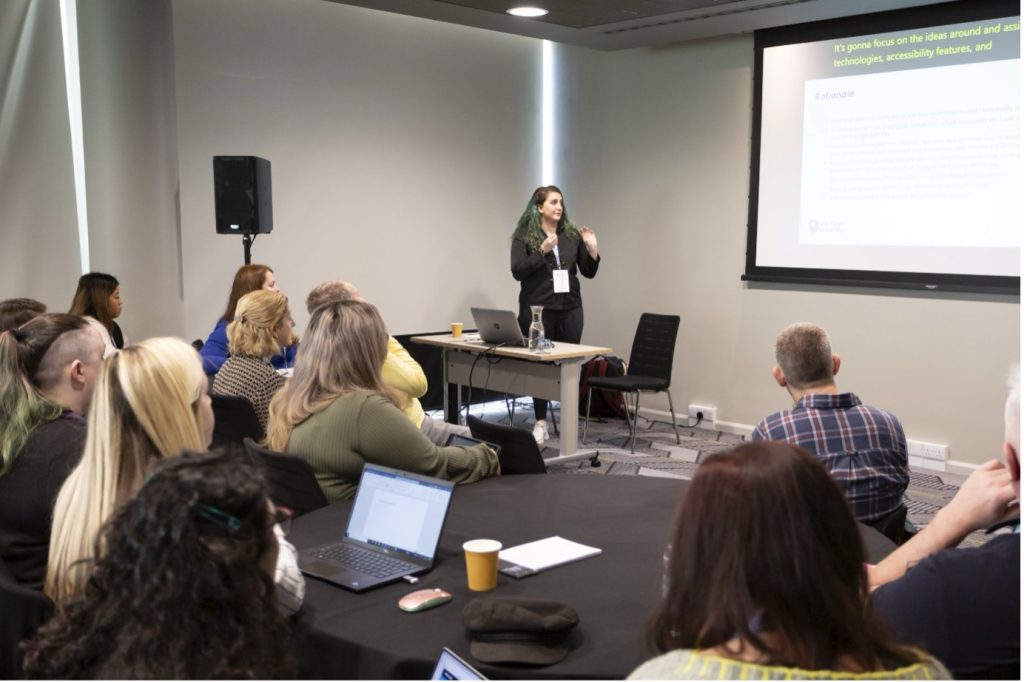
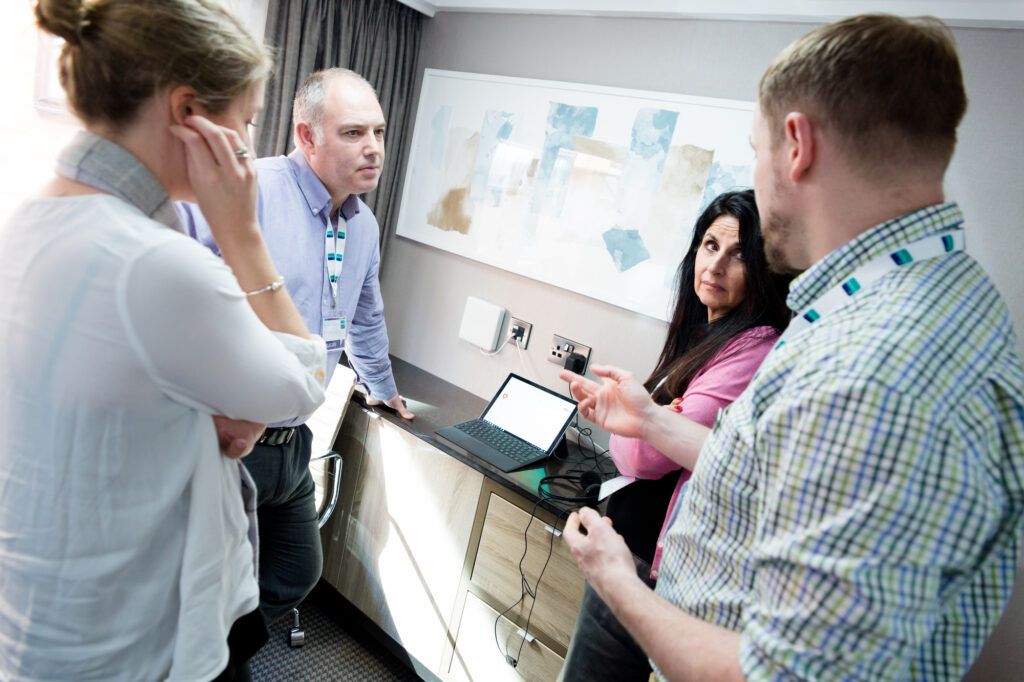
Hot off the press, we can confirm that TechAbility conference is planned for the 19th of November 2026. It’s not too soon to start thinking about what you could bring to the conference, or what subjects you’d like covered or guest speakers you would like to attend.
Evidence Review: Disabled people’s experience of UK education
The review highlights the importance of accessible digital learning materials, the option to complete assessments on computers rather than handwriting and the role of online learning in giving disabled learners greater control, flexibility and independence. It also finds that feedback is most effective when provided in formats compatible with assistive technology (ATech), such as editable text rather than scanned documents.
Champions: LinkedIn Recognition
For those of you who are or have a TechAbility Champion you can now have this added to your LinkedIn profile to recognise the commitment, work and development involved in the role.
In future we may open this to conference contributions so let us know if this would be of interest too.
National AI Awareness day: 4th June 2026
AI awareness day is a new national campaign aimed at exploring, debating and build skills around AI through engaging activities, creative challenges and important discussions about the individual and societal implications of using AI.
Although the campaign is aimed at schools, the resources are universally adaptable, and the subject matter is increasingly important.
TechAbility AT Champions – Do you have a champion?
All Karten Centres are entitled to nominate a TechAbility AT Champion. So why not take advantage of this?
The commitments are flexible, it will give you access to:
Quarterly meetings, facilitated by TechAbility, in which to share best practice, hear guest speakers, identify the latest updates/tech and open the floor up to queries or to promote what you are doing in your setting
New materials TechAbility develops
A community interested in developing the best support for AT users
Collaboration opportunities on AT projects and partnerships
Practical use of 3D printing to enhance educational access
Adventure playground for sound, noise and accidental music
From research to practice: An Assistive Technology journey
Accessible surveys and data collection
GenAI blurring the lines between personal and tech aids
Exploring the intersection of AAC and Assistive Technology
Plus
Amazing interactive musical keynote presentation
AT Supplier Exhibition
Hot topics discussions
If you want discounted accommodation, then you will need to book before 22 September. The details for booking hotel provided once you have booked your place and there are a limited number of rooms at discounted rate (£120).
Hope to see you there!
Webinars
Did you miss the Microsoft, Google and Dictation/Voice commands Webinars? They have been uploaded to YouTube so if you have a spare 20-25mins why not find out how this accessibility can help you!
Microsoft provide their accessibility features in a number of different areas, we’ll show you how to find them and where to start when making the Office suite more accessible. Microsoft Immersive Reader will be covered and this will serve as an introduction to in-built accessibility settings.
In this webinar we will explain how Google approaches accessibility and talk about how to access these accessibility features through a chrome browser or on a chromebook. Expect to learn about common accessibility tools such as text to speech, dictation, visual settings and more.
It has never been easier to write text with your voice, or to use commands to control your digital devices. So where to start? This webinar covers the key solutions for voice input and commands.
We will have a further webinar programme announced soon, so please watch this space…
TechAbility’s new webinar series is curated by digital accessibility and education specialist, Lisa Featherstone. The series launches in May with a discussion based around how technology can be used for learning. This session features some important questions to consider before introducing technologies to people who may require them for support. The June webinar then gives you a chance to consider those questions, looking at a specific technology – Assistiv.
The question I always ask when faced with a technology (old or new) is ‘how can I use that for learning?’ Lots of techie people tell you about the features that a technology has. The important question for teaching staff is – where is the learning?
What are the questions that you need to ask before introducing a technology to learners? The learners in question will also include yourselves – and me! We will discuss learners creating their own content – as well as some tools to help them in the process.
This is the first in a series of webinars looking at a variety of technologies, some well-established, others more recent. In addition to answering some of the questions above, this webinar will take a short journey through some technologies that we will be looking at in future.
Assistiv – Making work, work for everyone. 24 June 12:30
There is a well-established technology that we all have been using, everyday, for years. Assistiv has innovative ways of using this technology to benefit learners with learning difficulties be more independent and enter the world of work; possibly for the first time. Come along to discover how to help learners to fulfil their potential in employment by enhancing their independence skills.
The Oaks Specialist College is already trialling the system and a tutor will discuss the technology along with their students’ experiences. The CEO of Assistiv will also discuss the technology, its implementation and how it can transform real life work experience for learners.
90% of delegates at last year’s TechAbility Conference said they were very likely, or likely to apply learning from the conference in their workplace. TechAbility25 will give multiple opportunities to learn from leading practitioners in the field of Assistive Technology. All presentations and workshops will be grounded in practice and research. Alongside this will be opportunities to meet with Assistive Technology suppliers and discuss the solutions they provide.
As usual Karten members will receive a significant discount on the delegate price.
This year, the conference will take place at the East Midlands Conference Centre in Nottingham. The venue has excellent transport links to the whole of the UK.
Thank you to all that contributed to the TechAbility session: Making it fun: The importance of motivation in using Assistive Technology.
We covered Smart devices, Speech and Language Therapy using TikTok and much more. If you are interested in presenting next year then please email neil.harrodbeck@natspec.org.uk. We can help you to prepare and deliver, even if it’s your first time.
Bluesky: Skeets
Many of you are supporting people to stay in touch and access their interests through social media. If you are looking for a simple and transparent platform then Bluesky is now available. Many prefer the lack of adverts and a feed that shows only who you are following.
Skeets is a 3rd party iOS / iPad OS client for Bluesky to make it more accessible. The app offers a native look & feel that makes iOS & iPad OS users feel right at home. It has been optimised for accessibility, and they are aiming to improve this further to offer users a Bluesky experience without barriers.
Sense College Loughborough: Assistive Technology Event
From the 19th to the 23rd of May 2025 Sense College Loughborough are coordinating with the Access and Assistance for All (AAA) campaign that aims to increase access to assistive technology across further education colleges as well as raising awareness of how to make resources accessible by design so they are compatible with assistive technology.
Natspec Peer Exchange Week returns in January. Over the four days Natspec will be hosting online peer exchange sessions on topical subjects of interest to specialist college staff.
Natspec has ensured that Karten members will be able to access the TechAbility session: Making it fun: The importance of motivation in using Assistive Technology.
We would love to hear from Karten centres about how they work with their centre users to make technology fun and motivational. Please email neil.harrodbeck@natspec.org.uk if you would be interested in contributing. We can help you to prepare and deliver, even if it’s your first time.
Switch Adapted Inclusive MP3 Player
Inclusive technology has begun stocking a switch adapted MP3 player, to help people to listen to music, books or other audio.
This has a standard switch interface for Play/Pause, Forwards/Skip Track Forwards, Back/Skip Track Back meaning that you can connect whatever switches work best for the individual. It has a clear and simple interface making it easier for those who may struggle to find the right buttons. We would be tempted to use switches with stickers showing what each switch does.
Please let us know if you buy one as we’d love to know what you think of it.
Computer control coming to AI through Claude 3.5
Anthropic are the owners of the AI system known as “Claude.” In their latest version Claude can use computers the way people do—by looking at a screen, moving a cursor, clicking buttons, and typing text.
At this stage, it is still experimental—at times cumbersome and error-prone but they expect the capability to improve rapidly over time.
A demostration of Claude controlling the computer to acomplish the requested task.
For now this is only available for developers, but it is a clear indication of what is to come.
We hope that this will lead to people with disabilities being able to give short commands and for the AI to carry out a number of activities related to these commands. Simplifying the process, expanding what individuals can do and making it easier to carry out activities.
Building in the success of previous conferences, TechAbility2024 will give you multiple opportunities to learn from leading practitioners in the field of Assistive Technology. As ever, all presentations and workshops will be grounded in practice and research. Alongside this will be opportunities to meet with Assistive Technology suppliers and discuss the solutions they provide.
This year, the conference will take place in Leeds, which has excellent transport links to the whole of the UK. Based on your feedback there will be extra opportunities for discussion among delegates.
Two hot topic sessions will be run by our keynote speaker, Jane Seale, Open University who has a national and international reputation as an expert in the fields of disability, technology and inclusion.
TechAbility Standards: Developing an AI tool with Open University
Thank you for all those in developing this tool to take the TechAbility Standards and create an audit tool using Artificial Intelligence. The TechAbility Standards are the guide to what good looks like with organisations using Assistive Technology, everything from what tools to use, to how to support transition for users.
You can also hear about our proposed next steps, which include updating the TechAbility Standards and looking at how we roll these out further within the Educational Assistive Technology world.
The Open University’s CALRG (Computers and Learning Research Group)
TechAbility Champions: Karten centres supporting each other
The TechAbility champions program currently has 72 members, nominated from Karten Centres and Natspec Colleges.
TechAbility shared their new mobile app cards for Android devices with the Champions getting the first preview, the Apple equivalent is expected over the summer. They also shared various resources, including JISC’s AI essential materials, information on Ofsted’s approach to AI, updates on the AXS accessibility passport, and the use of escape rooms in education.
Members of the program continue to support each other by exchanging information on topics such as Alexa/Google Home devices, job descriptions for new Assistive Technology assistant roles, and tips for using Microsoft Edge keyboard shortcuts to access AI. They are also collaborating on methods for building CVs.
The TechAbility conference is expected to have a strong input from the Champions, demonstrating how the programme improves engagement. Does your Karten centre have a TechAbility Champion, or would you like to know more? Email Neil Harrod-Beck and he will be more than happy to help you.
TechAbility Conference 2024: Expression of interest to present
With the TechAbility conference on the horizon there is a call for presentations, to showcase excellence in Assistive Technology projects, practice, guidance or research.
Do you have something that you would like to submit? We’d love to hear from you, even if you are unsure of the details. The conference will be held in Leeds at Royal Armouries Museum, Armouries Drive, LS10 1LT on 21 November 2024. Sessions will be 40 minutes long. In previous years the majority of delegates have been from FE, HE and adult care settings.
Presentations are subject to review by a panel and you may receive follow-up questions or requests for clarifications. For all accepted presentations, the presenter will receive one free delegate place at the conference.
Submit your proposals before 26 April 18:00. You will be informed by 3 May 2024 if your presentation has been selected for the conference.
JISC Digifest 2024: Summary
JISC’s showcase digital teaching, learning and research event, Digifest, took place on 12-13 March 2024 at the International Conference Centre (ICC) Birmingham, and online.
TechAbility created a space collaboratively with JISC as part of the community hub where educational professionals could come and have a taster of different assistive technologies or talk with experts.
There was a heavy focus on Artificial Intelligence as you might imagine and the key takeaway was that with such a fast pace of advancement it would be prudent for organisations to decide on the key principles for the adoption of the technologies.
After speaking to the TechAbility Champions it was agreed that there should be an event to help support Karten centres and Natspec Colleges to create this set of principles, to help guide them to adopt the technology and support people with disabilities to make use of AI while remaining safe. We will email out further details, but feel free to express interest in this to neil.harrodbeck@natspec.org.uk in the meantime.
Android Mobile App Cards – New and updated!
This has been a popular resource among Assistive Technology professionals and so we are pleased to announce that our Android Mobile App cards have been updated, with new apps and clearer labelling.
It lists useful Apps for those with disabilities (or those supporting people with disabilities) and shows the app name, logo, QR code to the Play Store link and a brief description. It can be used as a digital resource, but also works really well to print, cut out and laminate to display or share with others.
If you would like to recommend an app to be listed in this resource then please let us know, you can email neil.harrodbeck@natspec.org.uk and the app will be reviewed before being added.
Watch this space for an Apple equivalent as we will be sure to share it as soon as it is complete.
Thank you to all those who attended and contributed to the TechAbility conference. The feedback has been great and there was a wonderful atmosphere on the day. There were popular sessions on AI, accessible music, switch access and original research.
It was difficult to sum up the range of sessions and stalls, but given the variety of experience the theme became Progress not Perfection, recognising that we are all on different journeys and have much to learn. This was our first year running the conversation sessions at the end of the day, we hope they were able to meet the expressed need of more time to talk to each other about key issues.
It’s never to early to start requesting what you would like to see for next year and if you would like to contribute. You are what makes these events work.
If you’d like to see a review, we have put together a short video to capture the day.
Peer Exchange Week – 22nd – 25th January 2024
Over the four days Natspec will be hosting sessions on topical subjects of interest to specialist college staff in different job roles.
TechAbility are hosting a session on Thursday the 25th of January at 1pm until 2:15pm entitled Assistive Technology – Improving provision where the TechAbility Champions will take you through the changes they have made to improve their provision through Assistive Technology. You can expect topics such as Literacy support, communication, independence and transition in this session and we have gained permission from Natspec for all Karten members to have access to this event.
HSBC Launch Digital Accessibility Training and Apprenticeships
In an effort to improve accessibility HSBC is sharing its digital accessibility procedures with 1000 staff at other companies.
They have also launched an accessibility apprenticeship programme for disabled and neurodiverse apprentices to work at HSBC, upon completion they will be offered a full-time permanent job.
This is great news as it will improve understanding of accessibility at a range of companies while improving the representation of people with disabilities at HSBC – in turn leading to more accessible banking.
Based on the popularity of our previous mobile apps webinar, TechAbility have created another packed full of useful apps in just 20 minutes.
You can use apps to be creative, find learning resources, improve language pronunciation and set students tasks using videos that they can respond to in kind. How about a tool that can answer questions using AI that includes pictures and sources? Or something to support mental health techniques such as Cognitive Behavioural Therapy? You can even use your Android phone to make calls, speak phrases and activate environmental controls at the press of a customisable button.
We will provide options for Android and Apple devices wherever possible with the majority being free or at least having free features. We will have time for questions after the session and would love to hear from you about your favourite apps.
This course will give staff the knowledge to help learners discover accessibility features and apps on phones, which in turn should reduce people’s requirement for human support to support basic skills.
Access the world through a mobile phone: more information and booking
Computers, tablets and phones have a wealth of accessibility options already built into the operating systems. All teaching and learning support staff should have an awareness of these features so they can remove barriers for learners.
This year, we’re excited to introduce an enriched conference experience through the addition of a Discussion Forum. Participate in themed discussion sessions or reconnect with peers you met earlier in the day. Although the Discussion Forum is free, places are limited and available on a first-come, first-served basis. Book now for TechAbility2023, as many have already taken advantage of this opportunity.
Conference sessions have been carefully curated so that whatever sector you work in there will be relevant content. Sessions include:
Using technology to enable physically disabled people to explore their sexuality. Victoria Pitt, Treloar School and College
Exploring the potential of AI for accessibility. Helen Nicholson, Jisc National Centre for AI
Improving the confidence and practice of communication partners. Alysia Martindale, Ambitious about Autism
Realising the benefits of technology in supported employment. Shamima Akhtar, Policy Connect
Inclusive storytelling – approaches to telling stories for all! Pete Wells, winner of Bett and ERA Awards
Beyond music therapy – hacking the paradigm. Lee Holder, The Music Works
Seven stages of switch development. Luke Thompson, The Pace Centre
Taking place at the easy-to-reach Radisson Blu Hotel, Stansted, TechAbility2023 is a must attend event for anyone who wants to use technology to support living and learning.
Make Technology Work for You Poster – Links now fixed
Apologies if you had issues with QR codes on our “Make technology work for you” poster. These are now fixed. The poster links to video resources which help people get the best accessibility features out of their tech whether using a mobile phone, a laptop or a tablet.
The videos can also be embedded in your VLE or SharePoint site to use in training resources.
Please note: The EFT website will be closing on 30 September 2023 with some content moving to: www.et-foundation.co.uk. However, not all content will be available, they suggest downloading any resources you would like.
TechAbility AT Champions: Building a community of practice
In Natpec’s recent blog post Neil Harrod-Beck talks about building a community of practice with the TechAbility champions by bringing together those responsible for Assistive Technology in Natspec colleges and Karten Centres.
AI Regulation and Inclusive by Design
A House of Lords report has called for UK national AI centre and top-down regulation. Embedding ‘do no harm’ into AI legislation is essential and AI regulation must be inclusive by design, the publication says.
TechAbility’s training and webinar programme continues to provide opportunities for you to update your knowledge on assistive technology. All sessions are easily accessible online and Karten members receive a 50% discount on courses. Webinars are free to attend.
Any of the courses can be delivered direct to your organisation to groups of staff, so you can make sure all staff are increasing their awareness and experience with accessible technologies. For more information please visit the training section of the TechAbilty website.
Upcoming online training and webinar programme dates include:
27 April 2023 Join one of our Assistive Technologists to discuss ten quick fire topics covering a wide range of assistive hardware, software and techniques.
3 May 2023 This training will guide college leaders through long and short term goals to enable your teams to remove barriers to using technology, supporting learners to succeed.
9 May 2023 How can you extend the life of older devices (e.g. laptops) that have slow boot up speeds and sluggish performance? Let’s find out the answer by joining this webinar.
16 May 2023 Computers, tablets and phones have a wealth of accessibility options already built into the operating systems. All teaching and learning support staff should have an awareness of these features so they can remove barriers for learners.
Almost 200 People gathered for the TechAbility conference in November last year. TechAbility22 was an amazing opportunity for people to learn and develop their skills in assistive technology. It was also a great chance to network with others working in the field.
Just a few of the highlights were:
12 Presentations from practitioners which covered a wide range of topics including: use of iPads by learners with highly complex needs, young people’s use of digital mental health tools, how to make the most of mobile technologies, using smart home solutions and how to make gaming accessible
16 Exhibitors showing how their products made a difference for disabled people when integrated into education and care settings
1 Keynote speech from Zoe Clark who shared her wide experience of working in multidisciplinary teams to deliver assistive technology solutions
1 High quality lunch and lots of refreshments (well, no one can learn on an empty stomach!)
Feedback showed that 97% of delegates would be applying learning from the conference in their work. TechAbility’s goal is to improve outcomes for the people you support so this excellent to hear.
We are currently confirming a venue for TechAbility23 in November. Make sure to keep an eye on the newsletter for more news about this year’s exciting and informative TechAbility conference. In the meantime, make sure to take advantage of the other webinar and training opportunities over the next few months. These are detailed in the events section below.
Disability Adjustments Passports
Updates were given to the All Party Parliamentary Group for Assistive Technology in November 2022 at Westminster. TechAbility were joined by TechAbility Champions from both Portland College and Queen Alexander to partake in the event and were able to ask questions regarding expanding this to further education and beyond.
Disability Adjustments passports can help employers to understand adjustments and in-work support, support access to work applications and reduce the need to reassess when moving into employment or between jobs. We’ll let you know when we hear of the next steps!
Tobii Dynavox is the market leader in assistive communication. Their custom designed communication aids and corresponding support system enable people with disabilities such as cerebral palsy, ALS/MND, autism, spinal cord injury and aphasia to communicate and live their lives.
In this webinar we will be exploring the AAC (Augmentative and Alternative Communication) aspects of Tobii products including communication packages and their features.
Alice Langley, an experienced Speech Language Therapist and Training Manager for Tobii Dynavox in the UK, will be taking us through the webinar with time for questions at the end.
Tobii Dynavox is the market leader in assistive communication. Their custom designed communication aids and corresponding support system enable people with disabilities such as cerebral palsy, ALS/MND, autism, spinal cord injury and aphasia to communicate and live their lives.
In this webinar we will be exploring the specific tools and features that can help with independence in education, work and for living.
Alice Langley, an experienced Speech Language Therapist and Training Manager for Tobii Dynavox in the UK, will be taking us through the webinar with time for questions at the end.
9 February 2023 This workshop introduces delegates to technologies which will enable learners to access desktop and laptop computers, tablets and phones
23 March 2023 Computers, tablets and phones have a wealth of accessibility options already built into the operating systems. All teaching and learning support staff should have an awareness of these features so they can remove barriers for learners
27 April 2023 Join one of our Assistive Technologists to discuss ten quick fire topics covering a wide range of assistive hardware, software and techniques
3 May 2023 This training will guide college leaders through long and short term goals to enable your teams to remove barriers to using technology, supporting learners to succeed.
The TechAbility Champions had their first meeting back after the summer, welcoming four new champions from Karten Centres and Natspec Colleges. Kellie Mote as special guest outlined the support that JISC offered, for member and non-members, key updates were given by TechAbility and excitingly Director of Policy Connect’s ATech Policy Lab: Robert McClaren will be special guest at the November meeting, date to be confirmed.
All Karten members have the opportunity to nominate a champion at their centre to receive peer support, TechAbility support, to offer opportunities for free software and special guests. Interested? Get in touch with Neil Harrod-Beck
Windows 11 updates
Microsoft has updated Windows 11. It includes live captions to generate captions on any content that has audio which will be helpful for those with hearing impairments and concentration issues. Voice access can let anyone control a PC with just their voice and is much improved from the previous Windows versions. The updates also includes some improvements to the focus and “do not disturb” modes.
There’s a new do not disturb button in the notification panel that can silence notifications if you want to focus on work, and you can even go one step further by creating a 30-minute focus session here that will remove the badge icons you see on the taskbar. In busy work or study environments this could be really helpful. You can read more on this article from Tom Warren, at the Verge: “Windows 11’s 2022 Update has something new for everyone”
Focus on apps
It’s a great time to share the Envision AI App as it has become free for all! It is a free smartphone app that articulates everyday visual information into speech and is available on both Android and iOS.
You can use it to read text in the world around you, scan documents to turn them into digital text, describe surroundings and objects, and even tell you who’s nearby. It’s available in 60 languages and is useful for people with visual impairments but also learning disabilities or any other print disabilities for that matter.
Zoë has a wealth of in-depth experience from her 20 years work within Electronic Assistive Technology (EAT) in the NHS. She will not only inspire, but give practical take-aways to further develop your Assistive Technology provision.
Zoë will discuss how simply having a good piece of technology, although useful, is not the only component of success. Even before assessment for technology a teacher, carer or family member needs to think about the potential of technology and the benefits it could have. At the assessment stage again everyone plays a part, the person being assessed, an assessor with relevant skills, family members and staff who know the person. Without the motivation of the person success will be limited, without the information and commitment from carers or family success will be limited and without a skilled assessor success will be limited. The work doesn’t end there, ongoing the person themselves and the people supporting them need to facilitate technology use.
Ensuring equipment is set up appropriately and that it does what the person wants are essential to success and involve everyone. Zoë will also highlight the importance of the ongoing support and the responsibility of others in that. This includes a robust system of maintenance for equipment and a route for reassessment or updating as the person requires, potentially as they get older or as their condition changes. Zoë will also highlight that even though everyone does not need technology, there is great importance in everyone having the opportunities to explore technology use.
Join us to learn from Zoë’s extensive knowledge and experience in the field of Assistive Technology, challenge your current thinking and develop your practice.
TechAbility 2022 sees us back with a face-to-face conference; essential CPD for anyone working in the field of Assistive Technology. You will have opportunities to hear a range of excellent speakers – all sharing their practice in this area and enabling you to do the same. The conference takes place on Wednesday 16 November at Conference Aston, Birmingham. An easy to reach venue with excellent facilities.
The theme of this year’s TechAbility Conference is ‘Assistive Technology – everyone’s responsibility’. This theme emphasises how assistive technology must be integrated well, and supported by all staff, to be successful. Presentations will highlight how this has been promoted and achieved in organisations through practice or research. We hope you agree it is a really exciting line-up and there are a few sessions yet to be announced.
Eleven workshops for #TechAbility2022 are now confirmed, with more to come! Here are some of the highlights:
Interactive iPad activities -a multi disciplinary approach: Jodie Tatlow, Treloar’s College
Treloar’s College have increased learners’ active and independent use of iPads on the Sensory and Interactive curriculum. A group consisting of Assistive Technologists, Occupational Therapists and a Speech and Language Therapist was formed to look at meaningful activities and how students could access these, especially for those who use access switches.
Jodie will demonstrate using Switch Recipes as a way of unlocking many apps and web programmes for learners who cannot use direct access. A training and support programme has been established so that the activities can be implemented by teaching and learning support staff.
Making gaming accessible: Tom Dore, British Esports
Great advances have been made in making gaming accessible to more people through physical adaptations such as the XBox Adaptive Controller and software adjustments within games. Giving people access to these adaptations can level the game playing field and enable inclusion in competitions. Tom will outline how these adaptations can make a difference and introduce the Specialist Colleges ESports Cup which has run in parallel for the last two years with the Association of Colleges Student Champs competition.
Tom will show how each adaptive equipment setup is unique, and provides opportunity for the user to be involved in gaming where they may have not been able to before. This levels the playing field and provides opportunities that may have been closed off to people previously.
Accessibility of Virtual and Augmented Reality: Dr. Chris Creed, Birmingham City University
Augmented and virtual reality (AR/VR) holds significant potential to transform how we work, learn, and engage with others. However, there has been a lack of work exploring the challenges associated with these technologies for disabled people. In particular, it is unclear the extent to which significant future uptake of this technology across the wider population could have a negative impact and further exacerbate the digital divide.
As such, there is an urgent need to understand the potential of these technologies to both support disabled people, but also to investigate the wider implications around the proliferation of AR and VR. Chris will describe how researchers at BCU are investigating the opportunities around AR/VR to support disabled people, such as those across the spectrum of visual, physical, auditory, and cognitive impairments.
Delivering SmartHome solutions: Rebecca Cooper and Trevor Edwards, Portland College
Portland College will present an overview of the implementation of their SMARTHome facility. This uses voice activation such as Alexa, Google and Bixby to aid independence, communication and wellbeing. Learners can control a wide range of devices from lighting through to washing machines, vacuum cleaners and fridges.
Partnership working, through an Multi Disciplinary Team approach was integral to the success of this project and included input from IT services, Occupational Therapy, Speech and Language Therapy, Education, Care, Estates, Finance. This approach demonstrates how partnership working within college and externally, has ensured that learners have the opportunity to meet their independence, communication and wellbeing outcomes.
We are still here over the summer! So if you haven’t booked a consultation yet or signed up to our TechAbility AT champions programme then why not chat to us about how we can help? No need for any previous knowledge and low demands on time. All part of being a Karten member with no additional costs. Just email techability@natspec.org.uk and we’ll do the rest.
BETT Advisory Board
We are happy to announce that BETT have appointed TechAbility’s Fil McIntyre to their advisory board, this will bring a great steer to including accessible technology to Europe’s largest EdTech event.
Neil and Fil have been speaking at various events including the Bett show in March. Neil was speaking at a Global Equality Collective session on how assistive technology supports equality and inclusion. While Fil’s talk was at a session about the future of assistive technology, he focused on the fact that some of that future is here already. The Built-in access people have already in their devices shows that assistive technology is now part of our everyday lives. These technologies, whilst not appropriate for all, are a part of the big picture of assistive technology and do much to break down barriers by showing that adapting your technology should not be an unusual occurrence.
Some of the technologies on show at Bett were really exciting, but both Neil and Fil were wowed by the OrCam Learn. This is a reading pen which scans text by being pointed at the page. This is such a new product that we can’t provide a direct link yet, but to get an idea of the capabilities see the OrCam Read. We have been reassured that the new OrCam Learn will be cheaper though. We are trying to get our hands on a loan version and plan to feature it in a TechAbility webinar very soon.
We are really keen to hear from Karten members at the TechAbility conference in November about what technology is achieving for them. If you have an idea for a presentation which shows how technology is transforming the lives of the people you support, please get in touch. Presentations featuring views and experiences of AT users were highly regarded by delegates in 2021 and this is something we are also seeking to promote in 2022.
TechAbility has a really exciting set of free webinars to attend between now and the summer including: Envision: Speaking out the visual world , 3D Printing and Accessible Gaming. As ever, you will get the most value from these webinars by attending live as you get to ask questions of the presenters and benefit from other peoples’ experience too.
The wide range of training courses from TechAbility are available on regular dates. We’ve recently changed the Built-in access course so that you can access this on a drop in basis, rather than booking for your organisation. Ideally, we think everybody who supports people with technology should undertake this course so they are aware of the potential of devices. However, you might want to use this as an opportunity to try out the course before deciding it needs to be delivered to other members of staff.
All of the TechAbility online courses are half price to Karten members. The calendar of events shows dates for all the courses and webinars in the next few months.
Finally, please remember TechAbility staff are part of the service to Karten members – we can answer questions and queries about assistive technology at any time. We can also provide your organisation with a free consultation which will look at how assistive technologies can be utilised more effectively in your service. The best way to get in touch is to email techability@natspec.org.uk and we’ll get back to you as soon as possible.
The TechAbility Conference is always focussed on assistive technology practice which makes a difference for people with disabilities. This year the conference is online and Karten members receive a significant discount on the attendance fee. What’s more, one fee will cover multiple attendees from your organisation.
You can expect to hear first-hand experience of assistive technology use, alongside a real “back to basics” focus on how it can overcome barriers. You will leave with a greater focus and understanding, led by the best practitioners in the field and carefully curated to keep sessions lively and relevant.
The interactive keynote will be especially interesting to Karten Centres, focussing on the role of technology for disabled people in care settings. Julie Eshleman from Leonard Cheshire is researching meaningful technology use and would like the people you support in Karten Centres to come along to her keynote session and share their opinions.
Other highlight sessions include:
How disabled people and carers/PAs use virtual assistants
The difference the right AT can make
Developing your own apps
The right technology supporting the learning journey
TechAbility have released an exciting range of courses, delivered online over the next few months. These courses are discounted for Karten members. If you require training for groups or all of your staff team these courses can also be delivered directly to you and tailored to meet the needs of your organisation.
Computers, tablets and phones have a wealth of accessibility options already built into the operating systems. In addition, Office 365, Google Classrooms and web browsers have many features to enable access. This session will:
Show how to enable these features to ensure learners have the access they need.
Discuss which settings which may support learners with particular impairments.
Allow time to trial the options for yourself (subject to organisations having sufficient computers/tablets)
Demonstrate solutions if the built-in settings are not sufficient.
Discuss the accessibility advantages of learners choosing which platform they use.
All teaching and learning support staff should have an awareness of these features so they can remove barriers for learners. Therefore, this course is only delivered in-house for a single organisation. This has the advantage of the content being weighted to match your technology provision e.g. Windows, Mac, iPad, Android.
10 practical steps to include more learners.
Ten quick fire topics covering a wide range of assistive hardware, software and techniques. An efficient way to raise awareness in staff teams of the multiple ways learners’ needs can be addressed. Some examples of the subjects covered are:
Using Your Voice to Type – Dragon, Google Drive, Windows, Mac
Office 365 Learning Tools – inbuilt tools to aid literacy
Making your Documents Accessible – it is digital, but can it be read?
Mind Mapping – a study and creative tool
Brain In Hand – support for Autism/Mental Health
Captioning – easy ways to use subtitles in live online and recorded teaching
Using your phone to read text and handwriting – iPhone and Android
Reading websites – why Chrome isn’t always the best browser!
iPad Accessibility – Reading options, guided access, magnifier and more
Scanning Pens – Straightforward handheld tool for reading text
Assistive Technology for Physical Access
Delivered by Assistive Technology specialists, this workshop will ensure delegates learn about technologies which will enable learners to access desktop and laptop computers, tablets and phones. There is a wide range of technologies designed to support learners with physical access needs, this workshop will:
Demonstrate a spectrum of physical access technologies
Highlight how good assessment can change outcomes
Discuss the differences each technology can make for learners
Show how software choices can enhance physical access
Discuss how using some technologies may be undesirable
Supporting Learners’ Assistive Technology at all stages of their college journey
The right support for assistive technology can make a significant difference to learners’ achievements and experience. Technology which learners arrive with may not support their study at college; technology which is suitable for use in college, may not be supported once the learner has left. This course focusses on key stages in a learner’s journey and highlights the appropriate support required for effective outcomes. Delegates will discuss the following areas:
Intake
Initial Assessment
Support protocols
Staff training
Assistive Technology review points and ongoing support
Transition plan – documentation, liaison, training
Voice control for accessibility
“Alexa, turn on my lamp”. Voice control devices are convenient for most, but for many people with disabilities they can be a solution to accessing information, entertainment and controlling their environment. This session will give an overview of the key technologies available, their advantages and limitations. There will also be practical advice on how to operate these in learning and residential settings, while safeguarding users. Subjects covered include:
Basic setup and access
Controlling the environment – lights, fans, TVs
How to use if you don’t have a voice
Using in a learning and/or residential setting
Tips and tricks
Future developments to aid accessibility – dysarthric speech access, AI bots
Emerging Technologies for Accessibility
Learn about cutting edge technologies which could change the way learners interact with the world. Some technologies are designed to enable access for people with disabilities, others are designed for convenience but enable access. Technology covered in this session includes, but is not limited to:
EyeControl – wearable, screenless communication device
Home control – use your voice to control your home
Virtual Reality – immerse yourself in an alternative world
Mixed Reality – augment the real world with objects and activities inside the real-world
Artificial Intelligence – what can it do?
Chatbots – what can AI contribute to learning
Remote robots
Eye control on phones
TechAbility have a series of webinars, all dates are given in the Events section of this newsletter.
TechAbility are ensuring that Karten Centres are supported with their assistive technology, despite the restrictions on face to face interactions. Instead of a single, face to face visit, Neil and Fil are holding multiple, shorter online meetings.
If observation of practice or areas is required this can still happen remotely. There may indeed be advantages for some centres to these new arrangements for example ensuring people who may be part-time or shielding are part of the process.
Centres can be prioritised for visits if this is necessary and the risks to the people you support have diminished.
TechAbility is available all year round to answer your AT questions, ideas and developments.
TechAbility conference
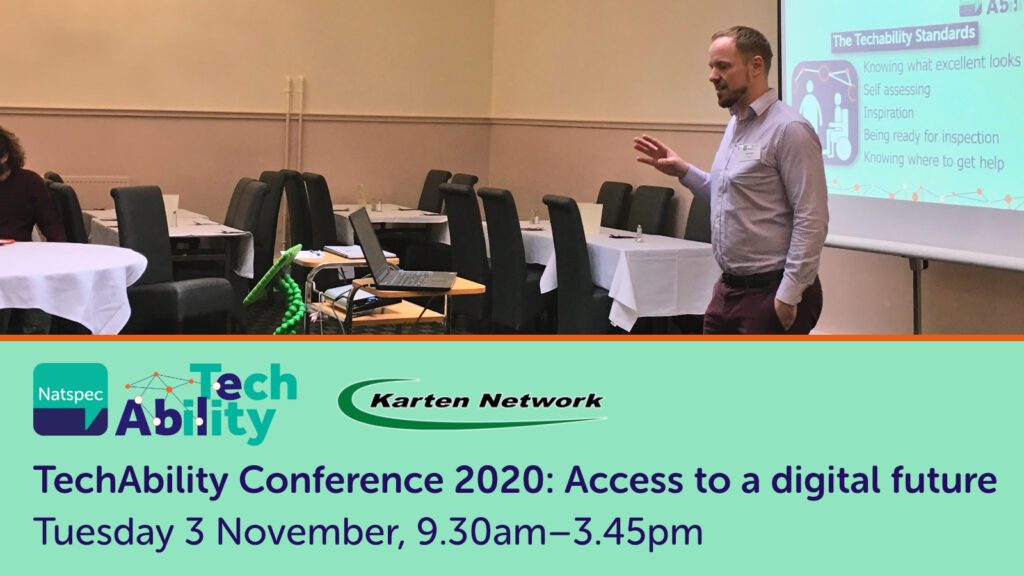
The TechAbility Conference goes virtual in 2020 with ‘Access to a Digital Future’. This one day event will bring together practitioners, experts and suppliers from across the assistive technology field. It will focus on what has been learnt throughout the COVID-19 pandemic, how organisations have adapted, the benefits to students, and how we ensure those are universal and continue going forward.
There will be two types of sessions happening throughout the day. The first, a series of 20 minute presentations, are practice based and provide practical solutions to issues you might be facing. The second, a series of 5 minute AT-shorts, highlight new AT projects, suppliers, and quick fire hints. There will also be opportunities for discussion and questions throughout the day.
Discounted rates are on offer for all Natspec Colleges & Karten Members
Confirmed workshops include:
Accessibility insights from remote assessment – Craig Brown, Hereward College
Apps for independence – lessons from delivering AT training in India – Neil Beck, TechAbility
Sensory rooms – getting it right – Carol Allen and Richard Hirstwood, Hirstwood Training
Become a qualified Educational Assistive Technologist – Rohan Slaughter
Widening access? The future of assistive technology policy in the UK – Clive Gilbert, Policy Connect
Using Amazon Echo devices with adults with Learning Disabilities and Autism – Carrie Sant, Fitzroy
In this webinar we will take a look at what training is available for those looking to take their knowledge around Assistive Technology to the next level – whether this is a short course or a Masters.
Adding text to your video calls or recordings can improve accessibility for a wide range of disabilities, is good practice and can help when sound issues occur. We will cover some of the main platforms with both paid and free tools.
We are joined by Jisc’s subject specialist for accessibility, Kellie Mote MSc MBPsS, to discuss her research and practice. Expect useful insights from an experienced Assistive Technologist about her investigations into the role of technology acceptance as an influence on young people’s willingness to use digital mental health interventions.
Claro Writing Helper helps you organise your essays. It guides you through a linear, structured approach starting with an essay question and a deadline, and ending with your essay in Word format! This exciting new product helps learners with disabilities to understand essay questions, set tasks, manage citations, create bibliographies and much more.
Are you working with learners who have English as a second language? We will review tools that can help to cross language barriers. This will include options on computers, tablets, mobile phones and AAC devices.
TechAbility has been working with Natspec Colleges and Karten Centres to improve the standards of Technology. This has been achieved through delivery of webinars, consultation visits, seminars and events.
One of the key findings during this time is the lack of guidance around what colleges/centres should be striving towards. There is an understanding that technology should be used, but without a clear view of how it should be used and to what ends.
For this reason we created the TechAbility Standards.
How to use them:
Starting point to improve technology use Audit tool or inspiration in an understandable format
Understanding how TechAbility can improve educational outcomes To encourage targeted and needs-led interventions
Quality Assurance/Inspection Measuring excellence with technology focused on learner outcomes.
The TechAbility 2019 conference was held in Birmingham on 21st November. Delegates found the event to be enjoyable, engaging and though-provoking. If you weren’t able to go along you can now access the conference materials.
The link below will take you to a page where you can download individual presentations from keynote speakers and workshops.
We use cookies on our website to give you the most relevant experience by remembering your preferences and repeat visits. By clicking “Accept All”, you consent to the use of ALL the cookies. However, you may visit "Cookie Settings" to provide a controlled consent.
This website uses cookies to improve your experience while you navigate through the website. Out of these, the cookies that are categorized as necessary are stored on your browser as they are essential for the working of basic functionalities of the website. We also use third-party cookies that help us analyze and understand how you use this website. These cookies will be stored in your browser only with your consent. You also have the option to opt-out of these cookies. But opting out of some of these cookies may affect your browsing experience.
Necessary cookies are absolutely essential for the website to function properly. These cookies ensure basic functionalities and security features of the website, anonymously.
Cookie
Duration
Description
cookielawinfo-checkbox-analytics
11 months
This cookie is set by GDPR Cookie Consent plugin. The cookie is used to store the user consent for the cookies in the category "Analytics".
cookielawinfo-checkbox-functional
11 months
The cookie is set by GDPR cookie consent to record the user consent for the cookies in the category "Functional".
cookielawinfo-checkbox-necessary
11 months
This cookie is set by GDPR Cookie Consent plugin. The cookies is used to store the user consent for the cookies in the category "Necessary".
cookielawinfo-checkbox-others
11 months
This cookie is set by GDPR Cookie Consent plugin. The cookie is used to store the user consent for the cookies in the category "Other.
cookielawinfo-checkbox-performance
11 months
This cookie is set by GDPR Cookie Consent plugin. The cookie is used to store the user consent for the cookies in the category "Performance".
viewed_cookie_policy
11 months
The cookie is set by the GDPR Cookie Consent plugin and is used to store whether or not user has consented to the use of cookies. It does not store any personal data.
Functional cookies help to perform certain functionalities like sharing the content of the website on social media platforms, collect feedbacks, and other third-party features.
Performance cookies are used to understand and analyze the key performance indexes of the website which helps in delivering a better user experience for the visitors.
Analytical cookies are used to understand how visitors interact with the website. These cookies help provide information on metrics the number of visitors, bounce rate, traffic source, etc.
Advertisement cookies are used to provide visitors with relevant ads and marketing campaigns. These cookies track visitors across websites and collect information to provide customized ads.